
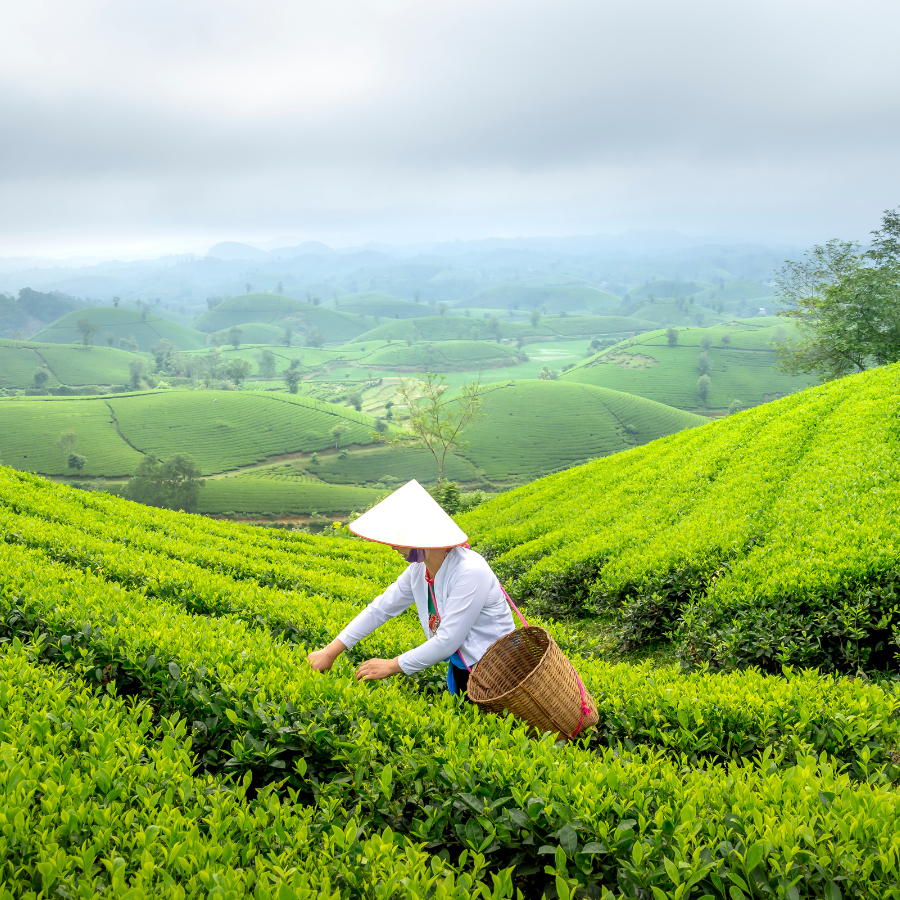
Over the past decade, beverage culture in the United States has undergone a profound revolution. Americans are no longer settling for just a rushed morning espresso or mass-produced, convenient tea bags. The rise of the “Specialty Tea” wave has ushered in a new era, where consumers crave single-origin tea leaves, meticulously steeped to fully experience their natural flavors and the cultural stories behind them.
Amidst this landscape, Vietnam—one of the world’s oldest cradles of the tea plant—is steadily stepping into the spotlight to introduce American connoisseurs to a true treasure: Tea leaves that carry the breath of misty mountains, the richness of mother earth, and the essence of thousands of years of culture.
Ancient Shan Tuyết Tea: A Living Heritage on Cloud-Kissed Peaks
While Americans are already highly familiar with Japanese Matcha or Indian Black Tea, Vietnam brings an entirely different masterpiece to the table: Ancient Shan Tuyết (Snow Mountain) Tea.
Deep within the dense, primeval forests of Northwest Vietnam (in provinces like Ha Giang, Yen Bai, Son La, and Lai Chau), at altitudes ranging from 3,900 to 6,500 feet (1,200 to 2,000 meters) above sea level, grow tea trees that are 300 to 500 years old. Unlike the short, commercially farmed tea bushes, Shan Tuyết tea plants grow tall like ancient timber trees, their trunks heavily blanketed in moss.
The name “Shan Tuyết” stems from this tea’s most unique characteristic: the surface of the young tea buds is always covered in a layer of fine, snow-white downy hairs. Surviving in harsh climates, shrouded in year-round mist with drastic temperature drops between day and night, Shan Tuyết tea leaves accumulate exceptionally high levels of antioxidants (catechins) and amino acids.
When poured into a cup at a teahouse in New York or California, Shan Tuyết yields a vibrant golden liquor with an aroma that faintly evokes wild orchids and raw forest honey. The elegant astringency that glides across the tip of the tongue quickly gives way to a deep, smooth, and profoundly lingering sweetness in the throat. This is a true “Zen” experience that tea lovers in the US are passionately hunting for.
Thai Nguyen Green Tea: The Bold Identity of Earth and Sky
Alongside the ancient teas, it is impossible not to mention Thai Nguyen Green Tea—a national beverage deeply ingrained in the Vietnamese subconscious. Located in the northern midland and mountainous region, Thai Nguyen possesses the perfect ferralitic soil and microclimate for the cultivation of premium green tea varieties.
Thai Nguyen tea stands out for its exquisite processing art. The young buds are hand-plucked following the strict standard of “one bud, two leaves,” and then undergo a high-heat pan-firing process (to halt oxidation) in traditional rotating drums. Using their bare hands to gauge the temperature, Vietnamese artisans shape and roll each leaf until it tightly curls into the shape of a fishhook, coated in a faint whitish bloom.
For the American palate, Thai Nguyen green tea is a delightful surprise. It does not possess the savory umami of Japanese green tea, nor is it as light as Chinese green tea. Thai Nguyen tea is characterized by its “astringent upfront, sweet finishing” profile (tiền chát, hậu ngọt)—a bold, robust first touch of light bitterness that immediately leaves a lingering, sweet aftertaste. Above all, it carries the incredibly captivating aroma of “cốm” (roasted young green rice).
The Art of Lotus Tea Scenting: The Pinnacle of Refinement
The US market has always loved floral-scented teas (such as jasmine tea or Earl Grey). However, Vietnam introduces a completely different echelon of floral scenting, widely considered the pinnacle of luxury and refinement: Lotus Tea.
Using absolutely no essential oils or artificial flavorings, traditional Lotus Tea (especially Tay Ho Lotus Tea from Hanoi) is scented using fresh lotus flowers hand-picked at dawn, just as the buds begin to bloom and are still kissed by morning dew. Artisans must carefully extract the tiny lotus anthers (known as “gạo sen”) to blend with premium green tea. It takes a staggering 1,000 to 1,500 lotus flowers to scent just one kilogram of finished tea, going through a meticulous process of layering and roasting that spans tens of days.
When introducing Lotus Tea to the US, we are not just selling a beverage; we are selling a handcrafted work of art. The harmonious blend of the sweet-astringent green tea and the elegant, regal aroma of the lotus creates a priceless culinary experience, completely winning over the most discerning guests at fine-dining restaurants and luxury tea boutiques.
Conquering the Market with Sustainable Values
The modern US market is a conscious one. Consumers want to know where their tea leaves come from, how the tea trees are grown, and whether the farmers are treated fairly.
The Vietnamese tea industry has been transforming vigorously to meet these stringent standards. In the high mountains of the Northwest, ethnic minority groups (such as the H’Mong, Dao, and Tay) still maintain wild-foraging methods, using absolutely no chemical fertilizers or pesticides. Tea cooperatives and producers are actively registering for international certifications like USDA Organic, Fair Trade, and Rainforest Alliance.
Transparency in the supply chain (Direct Trade) allows American consumers to trace the origin of their tea leaves right back to remote villages in Vietnam. When buying a package of Vietnamese tea, they know they are contributing to the protection of primeval forest ecosystems, supporting agroecology, and improving the livelihoods of impoverished ethnic minority communities.
Conclusion
The journey of Vietnamese tea leaves reaching the US market is a beautiful intersection of thousand-year-old traditions and modern lifestyles. From the misty mountain peaks, through the sun-tanned hands of farmers and the brilliance of tea artisans, every tea leaf carries within it a long, rich story of Vietnam’s nature and people.
For Americans, discovering Vietnamese tea is like unfolding a new treasure map. Neither loud nor rushed, Vietnamese tea leaves gently captivate the palate and the soul, inviting the drinker to slow down, take a deep breath, and savor the peaceful stillness hidden in every sweet sip.