In the United States, the nutritional nut market is witnessing explosive growth, driven by an increasing awareness of health and holistic lifestyles. Walking down the aisles of Whole Foods, Trader Joe’s, or Sprouts Farmers Market, American consumers do not hesitate to pay a premium for truly high-quality products. Within that diverse world of nuts, the Macadamia always sits proudly on the throne, rightfully holding the title of the “Queen of Nuts.”
Many Americans are already familiar with macadamias from Hawaii or their original homeland, Australia. However, in recent years, a surprising new breeze has steadily won over the most discerning customers in the States: Vietnamese Macadamia nuts. Despite being a “rookie” on the global macadamia map, Vietnam is proving that world-class quality and exquisite flavor can absolutely be cultivated in new lands.
A “Second Homeland” in the Central Highlands and the Northwest
The macadamia tree is notoriously finicky and highly selective about its ecological conditions. It demands a living environment with strict standards for temperature, rainfall, and sunlight. However, when brought to Vietnam for experimental planting in the early 2000s, the macadamia tree found a perfect “second homeland” in two distinct regions: the Central Highlands and the Northwest.
-
The Majestic Central Highlands (Lam Dong, Dak Lak, Dak Nong): The fertile, porous basalt red soil, combined with the year-round cool climate of the plateaus (especially in Lam Dong), has created an ideal environment for macadamia trees to flourish.
-
The Northwest Mountains (Lai Chau, Dien Bien): Boasting a large temperature variation between day and night along with characteristically cold winters, the climate here stimulates the trees to flower and bear fruit with incredibly impressive yield and quality.
It is exactly this unique “terroir” (soil and climate) that has forged macadamia nuts bearing a distinct Vietnamese signature: thin shells, large and perfectly round kernels, and a rich nutritional profile that rivals any other producing country in the world.
The Flavor Experience: An Explosion of Creaminess and Crunch
What gives Vietnamese macadamias the confidence to compete on American supermarket shelves? The answer lies in their absolute freshness and incredibly refined flavor profile.
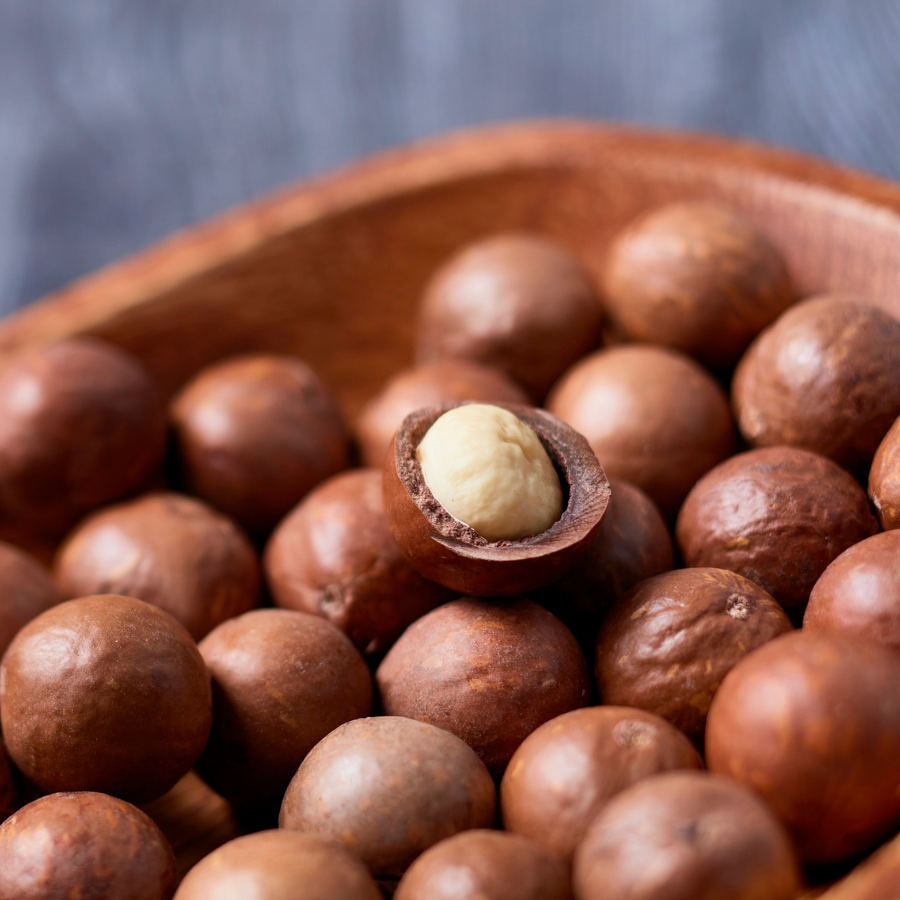
Vietnamese macadamia nuts stand out with a good fat (monounsaturated fat) content of over 70%. When you bite into a Vietnamese macadamia, the first impression is a satisfying, playful crunch, but immediately after, the kernel gently melts in your mouth like a piece of premium butter. It delivers a rich, nutty creaminess followed by a naturally sweet, captivating aftertaste.
Notably, Vietnam has introduced a unique tasting experience to the US market with its Crack-in-shell product line. Instead of completely removing the shell using industrial machinery—which can easily strip away moisture and natural oils—the nuts are cold-dried or lightly roasted, and then a small slit is pressed into the shell. American consumers are provided with a small metal key to manually pop open each nut. This “crack-and-eat” experience not only perfectly preserves the original, fresh flavor but also brings a fun, interactive joy to American families during gatherings.
Catching the American Health Wave
The arrival of Vietnamese macadamia nuts in the US is happening at a “golden” moment when diets like Keto (Ketogenic), Paleo, and Plant-based living are dominating the food scene.
With extremely low carbohydrate levels but an abundance of healthy fats, vitamins, minerals, and antioxidants, macadamias are a “superfood” highly recommended by American nutritionists. Processing plants in Vietnam are not just exporting whole roasted nuts; they are also actively supplying raw macadamia kernels for American brands to develop into high-value-added products, such as:
-
Macadamia Milk: An incredibly popular dairy alternative that boasts a superior creaminess and smooth texture compared to almond or oat milk.
-
Macadamia Butter: The perfect spread for whole-grain toast or a premium ingredient for high-end baking.
-
Cold-Pressed Macadamia Oil: A premium fat source used in salads or even as a luxurious skin and hair care ingredient in the beauty industry.
Overcoming Strict Barriers Through Sustainable Thinking
For containers of Vietnamese macadamias to dock at US ports, businesses have had to pass the world’s most rigorous inspection standards set by the FDA. Processing facilities in the Central Highlands and the Northwest now operate under international quality management systems like ISO and HACCP, utilizing modern drying technology to strictly control moisture and naturally prevent mold.
But more importantly, the story of Vietnamese macadamia is a story of Sustainability—a factor that modern American consumers care deeply about.
In the Central Highlands, macadamia trees are often intercropped with coffee or pepper plants. This agroforestry model not only provides shade, blocks wind, and prevents soil erosion, but also creates a diverse ecosystem that heavily restricts the use of chemicals. Tens of thousands of farming households, especially ethnic minorities in remote areas, have transformed their lives thanks to this “billionaire” tree. When Americans buy a bag of Vietnamese macadamia nuts, they know they are supporting green agriculture, promoting fair trade, and providing sustainable livelihoods for farmers halfway across the globe.
Conclusion
The journey of Vietnamese macadamia nuts—from the mist-covered hills of the Northwest and the sunny, breezy basalt red soil of the Central Highlands to the kitchens of American families—is a long and proud one. It not only affirms the incredible adaptability of Vietnamese agriculture but also serves as a firm commitment to world-class quality.
From a foreign seed, the macadamia tree has taken root and blended with the essence of Vietnam’s earth and sky to produce rich, creamy, ivory-white gems. For the US market, Vietnamese macadamia nuts are no longer just a luxurious snack or a high-end culinary ingredient; they are a symbol of global connection—where the exquisite taste of nature meets a healthy lifestyle and a deep appreciation for sustainable values.